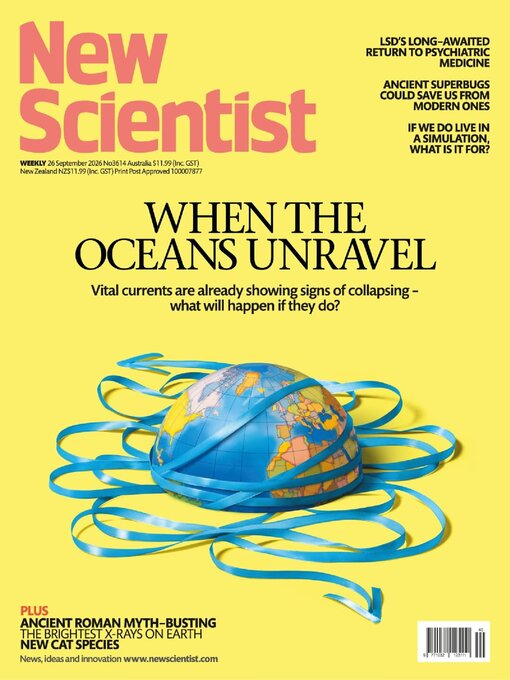
 Sep 26 2026
 Sep 19 2026
 Sep 12 2026
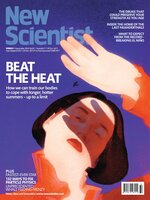 Sep 05 2026
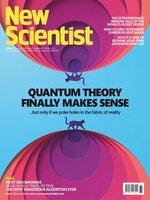 Aug 29 2026
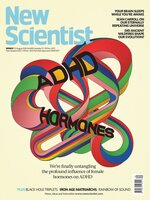 Aug 22 2026
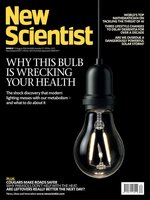 Aug 15 2026
 Aug 08 2026
 Aug 01 2026
 Jul 25 2026
 Jul 18 2026
 Jul 11 2026
 Jul 04 2026
 Jun 27 2026
 Jun 20 2026
 Jun 13 2026
 Jun 06 2026
 May 30 2026
 May 23 2026
 May 16 2026
 May 09 2026
 May 02 2026
 Apr 25 2026
 Apr 18 2026
New Scientist covers the latest developments in science and technology that will impact your world. New Scientist employs and commissions the best writers in their fields from all over the world. Our editorial team provide cutting-edge news, award-winning features and reports, written in concise and clear language that puts discoveries and advances in the context of everyday life today and in the future.
Tipping point • Just because the AMOC’s collapse is uncertain, it doesn’t mean we shouldn’t prepare
Mice given human brain organoids
Fast-flowing glaciers behind ice sheet shrinkage
Fundamental force is not so weak • A recalculation of the electroweak force could fix cracks in the standard model
Call to save sea life from El Niño • Oceanographers argue that reducing fishing quotas and testing geoengineering could help soften the impacts of an unprecedented temperature spike
Landmark trial could lead to LSD’s approval as anxiety treatment
Physicists explore dark matter clue • Following the possible recent detection of a dark matter particle, researchers have been devising a slew of models for what sort of particle it might have been,
Woman in ancient China had her nose amputated • The amputation may have been punishment for repeatedly stealing
Ukraine faces new aerial threat • Engineers are racing to design faster, more capable interceptor drones to tackle Russia’s new generation of jet-powered weapons, reports Matthew Sparkes
Brain implant lets people with paralysis speak and gesture at the same time
Wild chimps teach youngsters by handing them tools
Parthenon's illusions are a myth • Optical illusions thought to have influenced the design of the ancient Greek temple are not backed up by evidence, finds Chris Simms
Whale appears to grieve stillborn calf
Cosmic coincidences • The sun and moon are positioned just right for us to see total solar eclipses, and the make-up of the universe is just right for life. Leah Crane wonders if it's really all one big coincidence
Slimy character How do you get the science right in a sci-fi book? • Annalee Newitz describes how they made a slime mould the protagonist of their new science fiction novel
Dive-bomb
To the edge of empire • This sweeping yet intimate narrative of the Roman invasion of Britain and those on both sides who lived through it is impressive, finds Kelsey Hayes
Disappearing into dementia • The story of a family that loses many of its members young to an inherited condition explores grief, enduring love and medical hope, says Carissa Wong
Views Your letters
Trouble at sea • A crucial ocean current is at risk of shutting down. How close is this disaster and what happens next, asks Alec Luhn
Ancient superbugs to the rescue • As the world warms, antibiotic-resistant bacteria are escaping from frozen sediments. Joni Wildman explores how they can help us develop new medical treatments
"If this is a computer simulation, then it is a really, really good one" • Do we live in a simulation? Astronomer Royal for Scotland Catherine Heymans tells Jacklin Kwan the compelling reason why our reality could be synthetic
The back pages Almost the last word